
1. Project Overview & Situation
Codeo is a web development and digital strategy firm that helps businesses optimize their online presence through high-performance websites and Conversion Rate Optimization (CRO). In an industry where competition is stiff and attention spans are short, Codeo must deliver technically superior products that turn visitors into paying customers. To maintain a competitive edge, the team implemented Leo to serve as their central AI knowledge and collaboration hub.
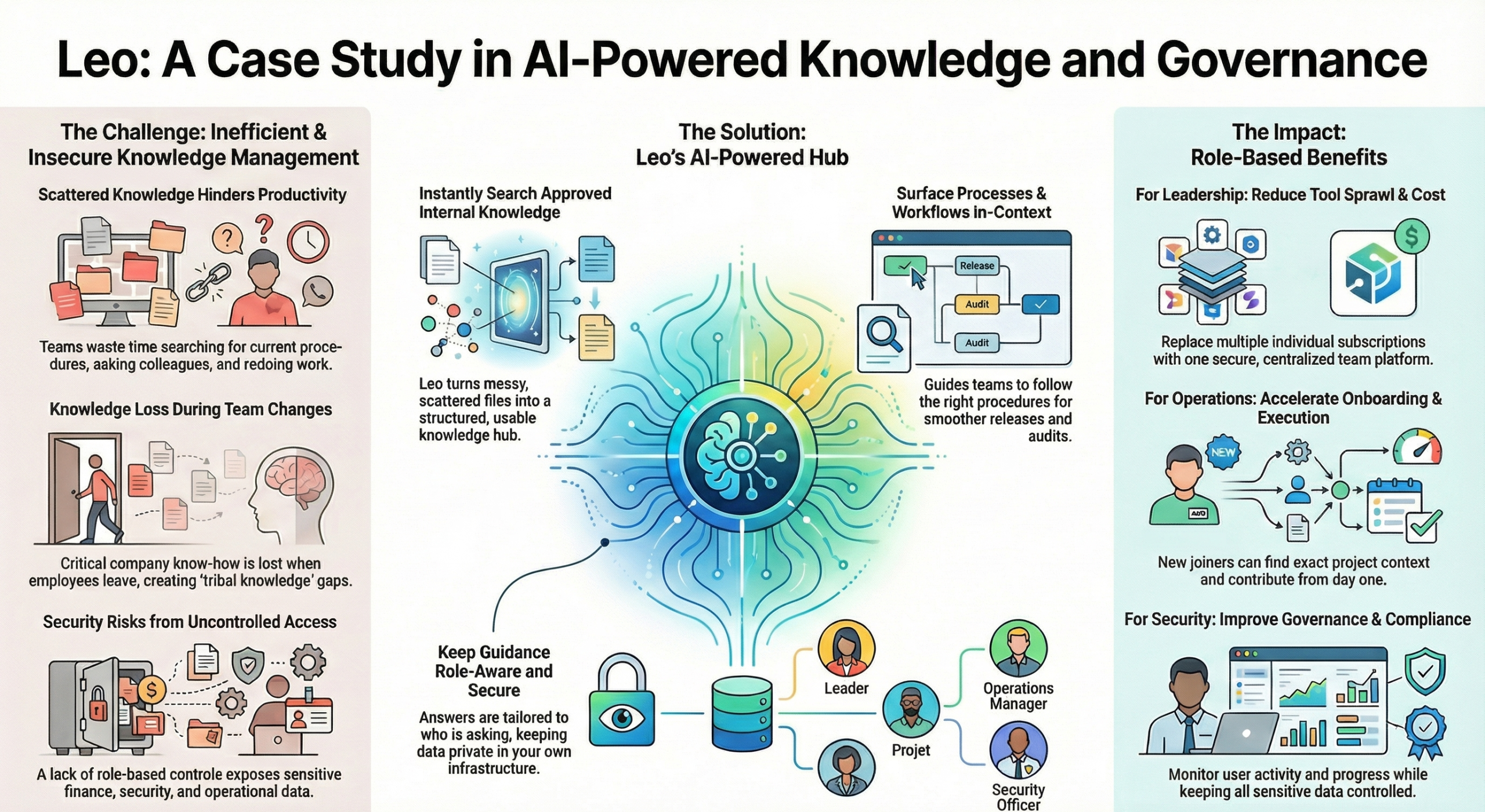
2. The Challenge: Tool Sprawl and Knowledge Fragmentation
Prior to adopting Leo, the web development team at Codeo faced several critical hurdles:
- Tool Sprawl and Cost: Developers and designers were using a fragmented array of individual AI subscriptions (e.g., different LLMs for code generation, research, and copy), leading to high costs and unmanaged “tool sprawl”.
- Knowledge Loss and “Tribal Knowledge”: Critical technical context, such as specific React components or custom API workflows, lived in private chats or the heads of senior developers, creating a risk that “tribal knowledge” would drift or vanish if a team member left.
- Security and Privacy Risks: Using unmanaged AI tools meant sensitive project data and proprietary codebases were being spread across external platforms, compromising data sovereignty.
- Inefficient Collaboration: Sharing AI-generated insights, prompt strategies, and research findings was manual and disorganized, slowing down the development lifecycle.
3. The Solution: Leo as a Unified AI Hub
Codeo integrated Leo to provide a “single place” for all AI models, resource sharing, and team collaboration.
- Centralized Multi-Model Access: Leo replaced multiple individual AI subscriptions with one secure team platform. This allowed developers to access the newest AI models in a single hub, ensuring they could switch between models for different tasks (e.g., complex logic vs. simple front-end copy) without leaving the corporate environment.
- Collaborative Chat and Resource Sharing: Leo turned “messy, scattered files” and private AI interactions into a structured knowledge hub. Teams could now share chats, save successful prompt templates, and link AI-generated research directly to project documentation.
- Role-Aware Governance: To protect sensitive client data (like finance or security controls), Leo kept all guidance role-aware. A junior web developer could access UI libraries, while only senior leads could view sensitive backend security protocols.
- “Moment of Work” Guidance: Leo was configured to surface the “current way we do things” at Codeo, such as approved React runbooks and A/B testing procedures, directly when the developer needed them.
4. The Approach: Enhancing the Development Lifecycle
The team utilized Leo across the standard UX and Product Design phases:
- Research & Ideation: Developers used the centralized AI to synthesize user research and generate personas based on demographic data. They shared these insights in collaborative folders in Leo to ensure the entire team remained aligned on the user’s “pain points”.
- CRO and A/B Testing: Drawing on best practices from giants like Amazon, the team used Leo to formulate hypotheses for A/B tests (e.g., testing “in-action” product images versus plain backgrounds).
- Engineering Velocity: By integrating Leo’s knowledge hub with their coding environment, developers could search for internal code-sharing frameworks instantly, rather than “asking around”.
5. Results and Impact: Quantifying Success
The impact of implementing Leo at Codeo was measured through specific productivity and business metrics:
- Reduction in Diff Authoring Time (DAT): By providing high-fidelity AI signals and approved internal knowledge early in the cycle, Codeo achieved significant gains in engineering velocity. Similar to Meta’s findings with auto-memoization and code sharing, Codeo saw an estimated 33% to 50% improvement in the time taken to author and land code changes.
- Consolidated Subscriptions: Leadership successfully reduced software overhead by replacing fragmented AI tool sets with Leo’s unified platform.
- Faster Onboarding: New joiners were able to contribute to web projects from “day one” because they had immediate access to the exact project context and historical team chats within Leo.
- Improved CRO Outcomes: By centralizing the research process, the team could implement UX changes that directly addressed friction points, leading to higher conversion rates for clients—such as reducing cart abandonment or increasing sign-ups.
Analogy: For the web development team at Codeo, using Leo is like moving from a fragmented library of loose-leaf papers to a high-speed, digital “Living Wiki.” Instead of every developer having their own private notebook (individual AI subscriptions) that no one else can see, they now have a shared, secure, and searchable “Company Brain” that updates in real-time and knows exactly what each person is allowed to see.