
Situation
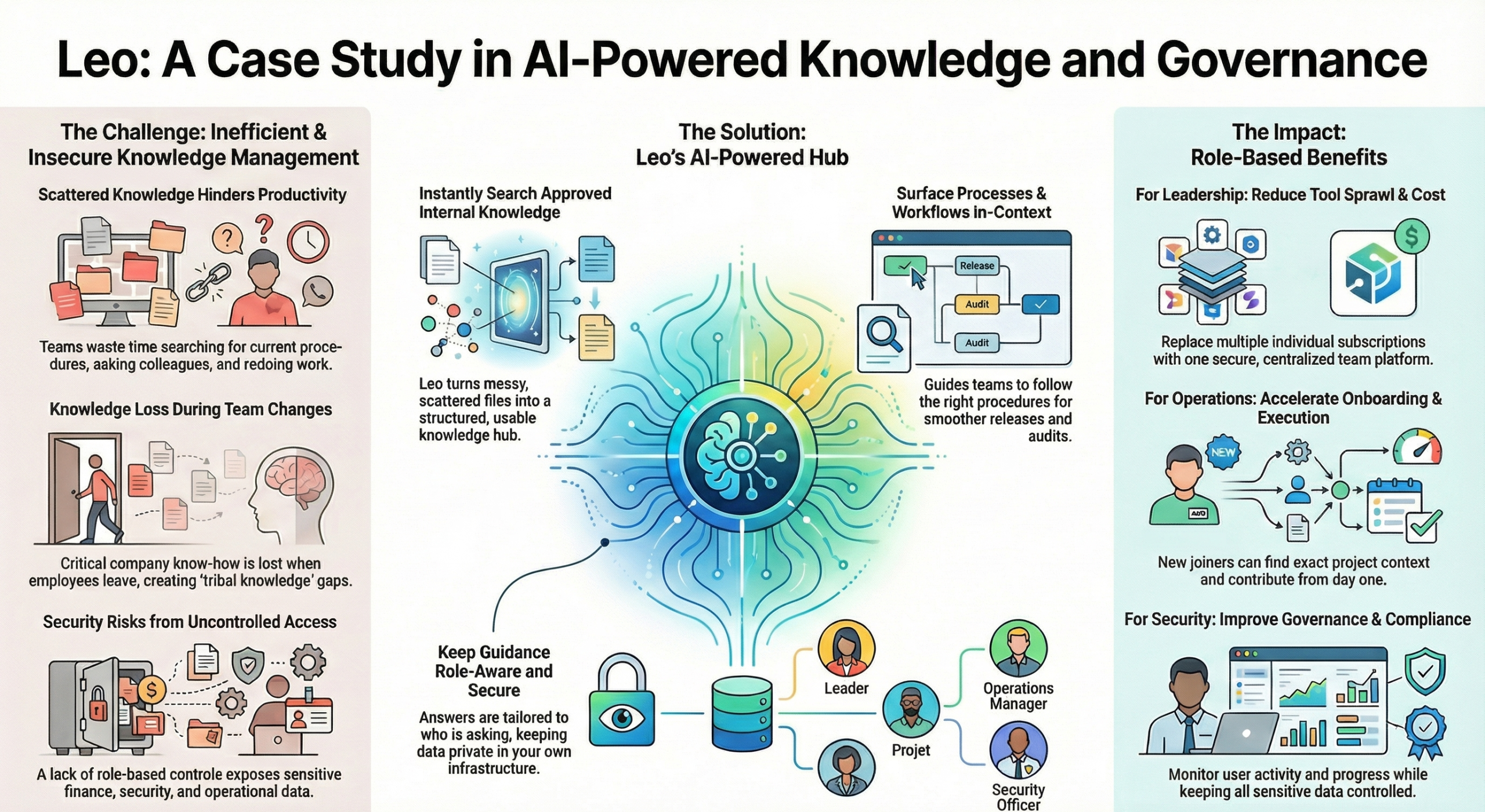
Arctiq operates in a high-stakes software development environment where speed and security are paramount. Before implementing Leo, the development team struggled with fragmented intelligence and tool sprawl. Engineers were using various individual AI subscriptions for code generation and research, which led to high costs and sensitive proprietary code being spread across unmanaged external platforms. Furthermore, critical technical context—often referred to as “tribal knowledge”—was drifting over time as it resided in private chats or individual notes rather than a centralized repository, leading to significant delays in onboarding and project execution.
Task
The leadership team at Arctiq sought to create a “single place” for all software development intelligence. The primary objectives were:
- Centralize access to the newest AI models to reduce redundant subscription costs.
- Enable secure resource sharing and collaborative team chats without compromising data sovereignty.
- Improve “Engineering Velocity” and reduce “Diff Authoring Time” (DAT)—the time engineers spend developing and landing code changes.
- Ensure role-aware governance so that sensitive security and operational data remained protected.
Activity
To achieve these goals, Arctiq deployed Leo as their core knowledge hub, focusing on three specific activities:
- Unified AI Model Access & Resource Sharing: Leo was used to replace multiple individual subscriptions with one secure team platform. Developers were able to use the newest AI models within Leo to brainstorm logic, generate code snippets, and synthesize research. Crucially, these interactions were not isolated; successful prompt strategies and technical resources were saved into a structured knowledge hub where the entire team could access them.
- Collaborative Chat & Execution-First Guidance: The team moved their technical discussions into Leo’s collaborative environment. By sharing chats, senior developers provided real-time guidance that remained searchable for junior team members. Leo also surfaced approved runbooks and workflows in the “moment of work,” ensuring developers followed current procedures during release cycles and incident responses.
- Role-Aware Governance Implementation: To protect Arctiq’s intellectual property, Leo was configured with role-based access. This ensured that while all developers could access shared UI libraries, only specific leads could see sensitive security controls or financial project data, keeping the information private and compliant.
Result
The implementation of Leo led to a paradigm shift in Arctiq’s development efficiency, mirrored by metrics found in large-scale industry leaders like Meta:
- Significant DAT Improvement: By reducing time spent “asking around” and redoing work, Arctiq saw a marked reduction in Diff Authoring Time. Based on similar technical implementations, this typically results in productivity improvements ranging from 14% to 33%.
- Thousands of Hours Saved: By making internal code-sharing frameworks and documentation easy to find, the organization estimated saving thousands of DAT hours annually through the reduction of redundant efforts.
- Reduced Tool Sprawl: Leadership successfully consolidated fragmented AI tools into one platform, significantly lowering overhead costs and improving oversight of user activity.
- Accelerated Onboarding: New joiners were able to contribute from “day one” because they had immediate access to the exact project context and historical team chats needed to understand the current way of doing things.
Analogy: For a software developer at Arctiq, using Leo is like having a shared, high-speed neural network for the whole team. Instead of each developer working in a silo with their own private AI assistant, everyone plugs into a collective “Company Brain” that remembers every breakthrough, secures every secret, and provides the fastest route to landing a clean piece of code.